
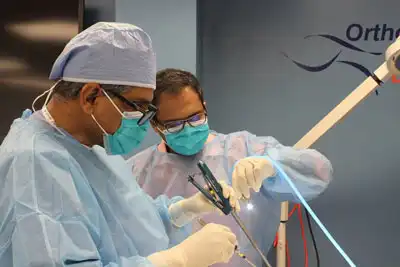
 A practical look at how surgical training labs support device adoption, physician education, and real-world procedural success.
If you talk to anyone on the commercial or clinical side of a medical device company, you’ll hear the same challenge come up again and again:
“We can explain the technology… but surgeons need to use it before they trust it.”
That gap—between understanding a device and confidently using it in surgery—is exactly why bioskills labs exist.
A bioskills training center gives medical device companies a place to run hands-on procedural training in a controlled, realistic environment. It’s where product education becomes muscle memory.
Explore the New York bioskills lab facility
Call now to schedule a training: (203) 869-2002
The Real Reason Device Training Needs to Be Hands-On
PowerPoint presentations don’t teach surgical technique.
Even the best-designed device can fall flat if the physician doesn’t feel comfortable using it in a real procedural setting.
I’ve heard this from multiple device reps over the years—especially during new product launches. One team had strong early interest from surgeons, but adoption stalled. Once they introduced hands-on cadaver training, everything changed. Surgeons who were hesitant became confident after performing the procedure themselves.
That’s the difference:
- Seeing a device → builds awareness
- Using a device → builds confidence
A cadaver lab for device training allows surgeons to:
- practice full procedural workflows
- understand anatomy in real conditions
- troubleshoot technique challenges
- gain confidence before operating on patients
See how our cadaver lab supports device training
Supporting Safe and Effective Device Adoption
From a regulatory and clinical standpoint, proper training isn’t optional—it’s critical.
Medical device companies use surgical training centers for physician education to ensure:
- consistent procedural technique
- reduced complication rates
- better patient outcomes
- alignment with intended use guidelinesv
Training in a hands-on surgical training lab helps bridge the gap between product design and real-world application.
And from a business perspective, well-trained surgeons are more likely to:
- adopt the technology
- use it correctly
- continue using it long-term
Have questions? Call our team: (203) 869-2002
A Controlled Environment for Real Surgical Training
A surgical training facility offers something hospitals and conference settings cannot: control.
In a bioskills lab, device companies can create a structured training experience where every variable is managed.
- standardized cadaver specimens
- identical surgical setups across stations
- controlled pacing of instruction
- immediate faculty feedback
That consistency matters. It allows companies to deliver repeatable, high-quality training experiences across multiple courses and locations.
View lab capabilities and setup
Ideal for Product Launches and Technique Training
When launching a new device, early impressions matter.
Bioskills labs are commonly used for:
- initial product launch training
- physician investigator meetings
- early adopter education programs
- implant technique training
- procedural validation
A well-run bioskills lab for medical device companies allows surgeons to leave the training with a clear understanding of:
- how the device integrates into their workflow
- how it compares to existing techniques
- where potential challenges may arise
Schedule a training consultation
Training That Mirrors the Operating Room
One of the biggest advantages of a surgical simulation lab for industry is how closely it replicates real surgical conditions.
Depending on the facility, companies can train using:
- arthroscopic towers
- fluoroscopy (C-arm imaging)
- laparoscopic equipment
- robotic-assisted systems
- ultrasound guidance
This allows for advanced surgical skills training across a wide range of procedures, including:
- arthroscopy
- endoscopic surgery
- laparoscopic techniques
- robotic surgery training
- ultrasound-guided procedures
Learn more about hands-on training environments
Content Creation and Surgeon Engagement
Another benefit that often gets overlooked: bioskills labs are excellent environments for creating training content.
Medical device companies frequently use labs to:
- film surgical technique videos
- create physician education materials
- record product demonstrations
- capture real procedural workflows
Because the environment is controlled, companies can produce high-quality educational content without the unpredictability of a live operating room.
Talk to our team about your next training event
Building Trust with Surgeons
At the end of the day, adoption comes down to trust.
Surgeons are cautious for good reason—they’re responsible for patient outcomes. No matter how innovative a device is, it won’t be widely used unless surgeons feel confident in it.
Hands-on training in a cadaver lab for physician training helps build that trust.
I’ve heard surgeons describe the moment it “clicks” during a training session—when the technique makes sense and the device feels intuitive. That moment rarely happens in a lecture. It happens during hands-on cadaver training for surgeons.
See how surgeons train in our lab
Why Location Matters for Device Training
Many medical device companies choose a bioskills training center in New York because of accessibility.
- bring in surgeons from across the U.S.
- host multi-day training courses
- coordinate with key opinion leaders
- run consistent national training programs
For companies running multiple training sessions throughout the year, having a reliable medical training lab space in a central location simplifies logistics.
Check availability for your training dates
When to Use a Bioskills Lab
Medical device companies typically use bioskills labs when they need to:
- train surgeons on a new device or technique
- refine procedural workflows
- demonstrate clinical applications
- gather physician feedback
- support commercialization efforts
Whether it’s a small focused session or a large physician surgical training course, the goal is the same:
turn knowledge into practical skill.
Ready to Host a Training Lab?
If you’re planning a medical device training course, cadaver lab, or physician education program, our New York bioskills lab is built to support every stage—from setup to execution.
View the facility and request details
Call now to speak directly with our team: (203) 869-2002
Real training drives real adoption.
And in medical device education, that’s what matters most.